


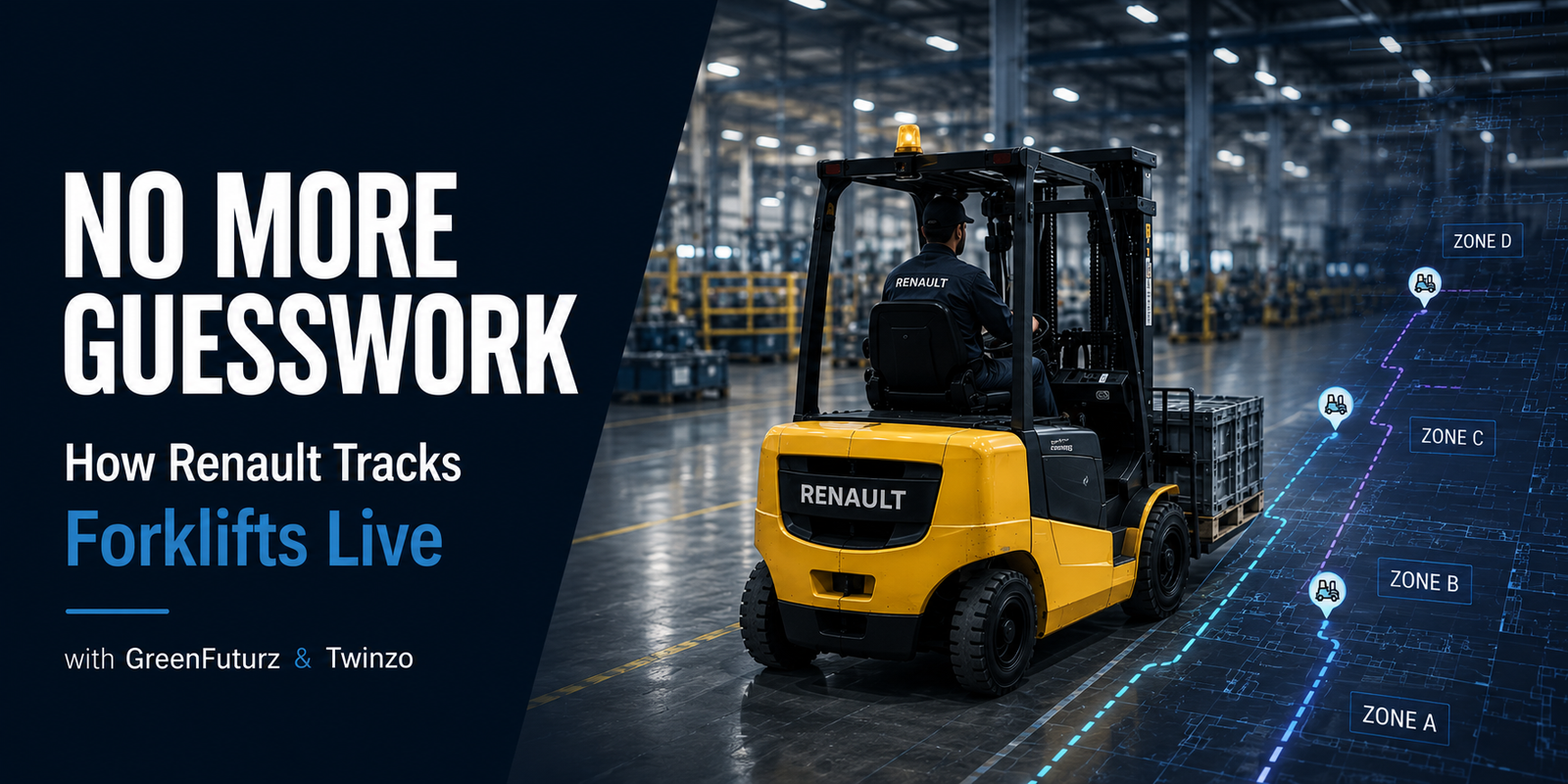
No More Guesswork: How Renault Tracks Forklifts Live with GreenFuturz & Twinzo
In today’s fast-paced manufacturing world, operational efficiency isn’t just a buzzword—it’s a necessity. Especially in large automotive plants, where even a small delay in material movement can ripple across the entire production line. This is exactly the challenge Renault faced inside one of its stamping facilities.
Forklifts were constantly moving critical materials across the shop floor—but visibility? Almost none.
That’s where GreenFuturz and Twinzo stepped in with a smart blend of operational technology (OT), BLE-based tracking, and a powerful Digital Twin platform.
The ChallengeThe Problem: Moving Assets, Missing Visibility
Inside Renault’s stamping unit, forklifts play a crucial role in transporting dies, raw materials, and finished components between stations. But like many legacy environments, the tracking of these forklifts was largely manual or dependent on supervisor observation.
This led to:
- Inefficient routing and idle time
- Lack of real-time location tracking
- Difficulty in analyzing utilization patterns
- Delays in identifying bottlenecks
In short, the plant had movement—but no measurable insight.
The ApproachThe Vision: Real-Time Intelligence through Operational Technology
The goal was simple yet ambitious: Create a real-time, digital representation of forklift movement across the facility.
To achieve this, GreenFuturz designed a solution rooted in operational technology, leveraging BLE (Bluetooth Low Energy) and integrating it seamlessly into Twinzo’s Digital Twin platform.
How It WorksThe Solution: BLE Meets Digital Twin
The implementation brought together three key layers:
1. BLE-Based Real-Time Tracking
Each forklift was equipped with a smartphone/tablet, while BLE tags were strategically placed across the facility to act as location anchors.
This reversed architecture enabled the mobile devices on the forklifts to continuously scan and interpret nearby BLE signals, allowing precise positioning within the shop floor.
This setup enabled:
- Continuous location tracking
- Zone-level accuracy
- Low power consumption and minimal infrastructure changes
Unlike traditional RFID or GPS systems, this BLE-based approach was specifically optimized for indoor industrial environments, offering greater flexibility and scalability without heavy infrastructure dependency.
2. Data Processing & Integration Layer
The captured data wasn’t just stored—it was processed in real time. GreenFuturz built a pipeline that:
- Aggregated BLE signals
- Converted them into meaningful location coordinates
- Filtered noise and improved positional accuracy
This ensured that only clean, actionable data flowed into the next stage.
3. Twinzo Digital Twin Platform
Here’s where things got visually powerful. Twinzo transformed raw movement data into a live, interactive Digital Twin of the factory floor.
What Renault could now see:
- Real-time forklift movement on a 3D model
- Historical playback of movement patterns
- Heatmaps of high-traffic zones
- Idle vs active time analysis
This wasn’t just tracking — it was storytelling through data.
End-to-EndProcess Flow in Action
The end-to-end flow looked something like this:
- Forklift moves across the shop floor
- BLE tags broadcast signals
- Gateways capture signal strength and proximity
- Data is processed and converted into coordinates
- Twinzo visualizes movement in real time
Simple in concept — but incredibly powerful in execution.
ResultsThe Impact: From Blind Spots to Full Visibility
Once deployed, the results were immediate and measurable:
Improved Operational Efficiency
Supervisors could now optimize routes and reduce unnecessary movement, leading to faster material handling.
Better Utilization of Assets
With clear insights into idle vs active time, Renault could balance workload across forklifts more effectively.
Data-Driven Decision Making
Instead of assumptions, decisions were now backed by real movement data and analytics.
Reduced Bottlenecks
High congestion zones were identified and restructured, improving overall plant flow.
What’s DifferentWhy This Use Case Stands Out
What makes this implementation unique isn’t just the technology — it’s how seamlessly it blends into existing operations.
- No heavy infrastructure overhaul
- Minimal disruption to ongoing processes
- Scalable across multiple facilities
It’s a perfect example of how operational technology and digital transformation can coexist without friction.
Looking AheadThe Bigger Picture
This isn’t just about forklifts.
It’s about unlocking visibility in industrial environments that have traditionally operated in silos. By combining BLE tracking with Digital Twin technology, GreenFuturz and Twinzo have shown how manufacturers can:
- Digitize shop floor operations
- Gain real-time insights
- Continuously optimize performance
ConclusionFinal Thoughts
In manufacturing, what you can’t see, you can’t improve.
By turning forklift movements into real-time, visual intelligence, Renault moved one step closer to a truly smart factory. And this is just the beginning.
With solutions like these, the future of operational efficiency is not just connected — it’s visible, measurable, and intelligent.